Reducing the cost of change

Posted on July 30th, 2010 in Agile, TDD by Jon Kruger

If there’s one constant in software development, it is change. Our entire workday is spent changing things and responding to change.

Every time you write a line of code, you are changing it. You might add new features, fix bugs, or make changes to existing code. However you put it, you’ll be changing the code.

Requirements will change. You often find this out after you’ve coded a feature, and now the business either changes their mind or you find out that you made some wrong assumptions.

Business priorities will change. What was important yesterday may not be important today, and six months from now, all kinds of things might change. There could be new, more important projects on the horizon, new people in charge, or new business opportunities.

Software development teams change too. You might stay at your company for many years, but during that time, you might get moved from project to project. Developers will leave the company, and others will join. The end result is that many different people will end up working on the code that you’re writing today.

Since we know that we are going to have a lot of change, it would therefore make sense to reduce the cost of change so that we can respond to change as quickly and easily as possible. So how can we reduce the cost of change?

Automated Testing

Every time I add a line of code, I risk breaking my application. Breaking the application is just not acceptable. We’ve come to accept bugs as a part of the process, but that doesn’t mean that it’s OK to write bugs. If you’re not striving to write bug-free code, then maybe you need to raise your standards.

Nevertheless, the fact is that we all screw up and we all have the capability to create bugs. Knowing that, I want a way that I can easily test my application so that I can ensure that I find out if I broke something once I change it.

On my current project, I’m writing an application that helps my client bid on construction projects. They can’t afford to have bugs in their system that will cause them to incorrectly bid on these jobs or they could be out a lot of money. The bottom line is that it has to work because their entire business is now running on the application that I’m writing. They also come to me on a regular basis with new feature requests and things they need changed. They don’t want to wait months to get this functionality, and they also don’t want me to break any existing code.

Thankfully I have a large suite of automated tests that I can run to ensure that I didn’t break anything. This isn’t foolproof and things sneak through, but it’s usually little stuff that isn’t critical. But it’s good enough proof for me that I didn’t break the existing functionality. As a result, I can release to production daily and I spend virtually no time manually regression testing my application when I deploy. My unit test suite has reduced my cost of change to pretty much just the time it takes me to code the changes, so now I can react quickly to changes, release all the time, and I can do it without breaking existing code.

Clean Code

Sometimes people will write their unit tests, write the code to make the tests pass, and then assume that that is good enough. That’s great that you wrote tests, but how easy is it for someone to make a change in your code?

I feel that clean, readable code is very underrated these days. When you write code, are you thinking of the person that is going to need to understand what you did once you’re not around anymore? That scenario is very likely to play out at some point. So when you write code, create methods, variables, and classes that are very descriptive. Place a priority in making your code easy for someone else to read.

“Clever code” is the opposite of clean code. I’m talking about using complex algorithms to solve simple problems, trying to using a complicated LINQ statement to do an operation that would be more readable in a foreach loop, or trying to implement something in the fewest lines of code as possible. There are times where you might want to do things like this, but usually it’s more important to write code that is easier for someone else to read and understand. Again, remember that someday someone else is going to have to change your code, so write descriptive code that makes it easier for that other someone to know what to do.

Tests Are Documentation

Your unit tests are documentation of what your code is supposed to do. I practice behavior driven development, which means that my unit test methods describe some business functionality that my code is in charge of executing. This way, if someone needs to know what my code does, they can look at the test classes and methods and see what it is supposed to do.

Lately I’ve started adding a lot more comments in my test methods. The class names and methods names may describe what the code is supposed to do, but it doesn’t always explain why. I’ve found that sometimes it helps to write down the why because that is also important information. Since people can look at my tests as documentation of what my code does, I figured that this would be the best place to put the whys, because if someone has to change my tests, they’ll immediately know why I did what I did and they’ll have a reminder that they need to update my comment.

Build Iteratively

Since business priorities and requirements are going to change, we want to reduce the cost of this change too. If the business comes to you and drastically changes the requirements or certain assumptions that you might’ve made, it might be really costly and painful to change, and you can only do so much about that. What we can do is make sure that we’re constantly checking back with the business to see what they want now so that we have as few surprises and as little rework as possible.

This is one reason why Agile projects often run on iterations. As a part of this process, meet with your business sponsor every week or two and talk about what you’re going to do next. Show them what you’ve done in the last week or two, and make sure you’re on the right track. This way, if they’re going to change their minds, you’re giving them permission to do so and you can adjust what you’re doing as soon as possible so that you have the least amount of rework.

Always Be Aware of Change

Quit thinking short-term and quit shoving code in just to get it done as fast as you can. You may think you’ve done something good by getting it done faster, but if you create more work and pain in the future, it’s a net loss. Instead, always think about what the effects of what you are doing now will be two years from now. Your goal is to create business value without creating technical debt. A home builder can do shoddy construction and put nice looking paint and siding on the house, but 10 years from now when the problems arise, people won’t be thinking very highly of that builder. Don’t make the same mistake. Take pride in your work and strive to always leave your code base cleaner than you found it.


Kick It on DotNetKicks.com

Specs2Tests: turn those acceptance criteria into BDD tests

Posted on May 10th, 2010 in TDD, unit testing by Jon Kruger

I had a simple problem today. I had to turn this:

When depositing money into an account
- should add the specified amount into the account

When withdrawing money from an account
- should withdraw the specified amount from the account
- should specify that the withdrawal was successful

… into this:


[TestFixture]
public class When_depositing_money_into_an_account : Specification
{
    [Test]
    public void should_add_the_specified_amount_into_the_account()
    {
 
    }
}
 
[TestFixture]
public class When_withdrawing_money_from_an_account : Specification
{
    [Test]
    public void should_withdraw_the_specified_amount_from_the_account()
    {
 
    }
 
    [Test]
    public void should_specify_that_the_withdrawal_was_successful()
    {
 
    }
}

I really didn’t want to do all of this typing every time, so I wrote code to do it for me. It works like this:

1) Copy the acceptance criteria text onto the clipboard
2) Run Specs2Tests.exe (will put the code onto the clipboard for you)
3) Paste the code into your code file

Now I can get all of my acceptance criteria nailed down in a text file where I don’t have the ceremony of a programming language, then let something convert them into tests. Since I just cranked this out today, I’m guessing that it doesn’t handle every scenario that you might think of, and it only writes out C# code. There is no reason that it couldn’t spit out VB.NET, RSpec, or anything else. If it doesn’t do what you want, get on github, create a fork, and send me a patch!

The code is here: http://github.com/jonkruger/specs2tests. Have fun.


Kick It on DotNetKicks.com

TDD Boot Camp upcoming events - coming to a city near you

Posted on April 28th, 2010 in TDD by Jon Kruger

If you read my blog at all, you know that I’m passionate about test-driven development. A few months ago, I announced that I was developing a TDD training course called TDD Boot Camp that will teach you everything that you need to know to do test-driven development on real world .NET projects.

I currently have two upcoming events scheduled: July 13-15 in Columbus and August 18-20 in Detroit. You can find out more details on what we’ll cover and how to register at the TDD Boot Camp website. If you can’t make any the events or if you would like me to come to your company, send me an email and we can work something out where I can come to you.

If the whole idea of test-driven development is new to you, or you’re not sure why you should care, come to the Path to Agility conference in Columbus on May 27, where I’m doing a talk on Test-Driven Development In Action. I’ll show you how TDD works and how it can help you deliver IT projects with higher quality, lower maintenance costs, and more peace of mind. Actually, you should go to the conference either way, because there is an excellent lineup of sessions for anyone involved in IT.


Kick It on DotNetKicks.com

How to use Rhino Mocks - documented through tests

Posted on March 12th, 2010 in .NET, Rhino Mocks, TDD, unit testing by Jon Kruger

I wanted to come up with a way to show people how to use Rhino Mocks (other than telling them to read the documentation). What better way to do this than by showing you how it works through a bunch of simple unit tests that document how Rhino Mocks works?

So that’s what I did. You can view the code here, or if you want to download the whole project and run the tests, you can get the whole thing here.

(If you’re interested in Moq, how it compares to Rhino Mocks, and to see Moq documented through tests, check out Steve Horn’s post.)

UPDATE: Fixed the test that was incorrectly showing how to use Expect() and VerifyAllExpectations(). Thanks to Sharon for pointing this out.


Kick It on DotNetKicks.com

A response to the SWE101 attendees who tried to solve the TDD problem without TDD

Posted on March 2nd, 2010 in TDD by Jon Kruger

This weekend we did some live TDD at the Software Engineering 101 event and broadcast it over LiveMeeting, which was a lot of fun. However, some people have posted solutions (here and here - see first comment) on how they solved the Greed scoring problem without using TDD.

I think you missed the point. The point was to help you learn the TDD thought process and how to put TDD into practice. There are lots of benefits to TDD, and I’ll use these non-TDD examples to illustrate.

How do you know your code works?

Those of you who solved the problem without TDD probably did some sort of manual testing in order to prove that your code is working. You could probably do that with a simple example like the one we had (there were only a few scoring rules). But what happens as we add rules (and in real life we’re always adding rules) and you have to manually test 16 rules? For the record, I took the solution posted here and ran my tests against it.

failing test

Tests are documentation

Tests document what the code is supposed to do. Since we wrote our test methods as sentences that read like English, you can figure out the rules just from reading our tests (as you can see in the image above). This is not documentation in Word format which becomes stale, this is living, breathing executable documentation of what the code is supposed to do.

Readability is important

I feel that the solution that we ended up with was very readable. Here is our implementation code:


public class GreedScorer
{
    public double Score(params Die[] dice)
    {
        var score = 0;
 
        score += ScoreASetOfThreeOnes(dice);
        score += ScoreASetOfThreeTwos(dice);
        score += ScoreASetOfThreeThrees(dice);
        score += ScoreASetOfThreeFours(dice);
        score += ScoreASetOfThreeFives(dice);
        score += ScoreASetOfThreeSixes(dice);
        score += ScoreEachOneThatIsNotAPartOfASetOfThree(dice);
        score += ScoreEachFiveThatIsNotAPartOfASetOfThree(dice);
        return score;
    }
 
    private int ScoreASetOfThreeOnes(Die[] dice)
    {
        if (dice.Count(die => die.Value == 1) >= 3)
            return 1000;
        return 0;
    }
 
    private int ScoreASetOfThreeTwos(Die[] dice)
    {
        if (dice.Count(die => die.Value == 2) >= 3)
            return 200;
        return 0;
    }
 
    private int ScoreASetOfThreeThrees(Die[] dice)
    {
        if (dice.Count(die => die.Value == 3) >= 3)
            return 300;
        return 0;
    }
 
    private int ScoreASetOfThreeFours(Die[] dice)
    {
        if (dice.Count(die => die.Value == 4) >= 3)
            return 400;
        return 0;
    }
 
    private int ScoreASetOfThreeFives(Die[] dice)
    {
        if (dice.Count(die => die.Value == 5) >= 3)
            return 500;
        return 0;
    }
 
    private int ScoreASetOfThreeSixes(Die[] dice)
    {
        if (dice.Count(die => die.Value == 6) >= 3)
            return 600;
        return 0;
    }
 
    private int ScoreEachOneThatIsNotAPartOfASetOfThree(Die[] dice)
    {
        if (dice.Count(die => die.Value == 1) < 3)
            return (dice.Count(die => die.Value == 1) * 100);
        if (dice.Count(die => die.Value == 1) > 3)
            return ((dice.Count(die => die.Value == 1) - 3) * 100);
 
        return 0;
    }
 
    private int ScoreEachFiveThatIsNotAPartOfASetOfThree(Die[] dice)
    {
        if (dice.Count(die => die.Value == 5) < 3)
            return (dice.Count(die => die.Value == 5) * 50);
        if (dice.Count(die => die.Value == 5) > 3)
            return ((dice.Count(die => die.Value == 5) - 3) * 50);
 
        return 0;
    }
}

Look how readable our code is. Read the score method. Notice how it tells you exactly what it’s doing. Contrast that with one of the other solutions:


static int Score(int[] numbers)
{
    int valueToReturn = 0;
 
    for (int numberIndex = 0; numberIndex < numbers.Length; numberIndex++)
    {
        switch (numbers[numberIndex])
        {
            case 1:
                if (
                    (numberIndex + 1 < numbers.Length && numbers[numberIndex + 1] == 1) &&
                    (numberIndex + 2 < numbers.Length && numbers[numberIndex + 2] == 1)
                   )
                {
                    valueToReturn += 1000;
                    numberIndex += 2;
                }
                else
                {
                    valueToReturn += 100;
                }
                break;
 
            case 5:
                if (
                    (numberIndex + 1 < numbers.Length && numbers[numberIndex + 1] == 5) &&
                    (numberIndex + 2 < numbers.Length && numbers[numberIndex + 2] == 5)
                   )
                {
                    valueToReturn += 500;
                    numberIndex += 2;
                }
                else
                {
                    valueToReturn += 50;
                }
                break;
 
            default:
                if (
                    (numberIndex + 1 < numbers.Length && numbers[numberIndex + 1] == numbers[numberIndex]) &&
                    (numberIndex + 2 < numbers.Length && numbers[numberIndex + 2] == numbers[numberIndex])
                   )
                {
                    valueToReturn += 100 * numbers[numberIndex];
                    numberIndex += 2;
                }
                break;
 
        }
    }
 
    return valueToReturn;
}

To me, this code is not very readable. If you had to implement a new rule in this method, it would be hard to do (plus you have no tests to tell you that you broke an existing rule).

The point of this exercise was not to find a clever way to solve a brain teaser. If you want to do a brain teaser, try and write code that will output a Fibonacci sequence using one LINQ expression. That’s the kind of geek stuff that you might do at night for fun. But when you’re writing real code, we care about things like readability and maintainability. When you’re writing implementation code, use common language and write methods whose names tell you what they do.

TDD leads to well-designed code

As we were writing our first test, our test told us that we needed some class that would score the Greed game. So we named it GreedScorer, which does exactly what the name intends. This class will most likely end up following the single responsibility principle because we gave it a very specific name.

But you guys took so long!

We weren’t trying to finish as fast as possible. We were not doing a coding competition. We were practicing and learning the TDD mindset and trying to explain things as we went. As you get better at TDD, it becomes more natural and you learn tricks that help you go faster (for example, sometimes writing a whole bunch of tests, watching them all fail, then making them all go pass is faster than just writing one test at a time and making them pass one at a time).

The bottom line is that we came out with some good, readable, maintainable code (with props to Sirena who helped write it). We were able to prove that our code is working. We don’t have any code that we don’t need. We could easily respond to change and implementing new scoring rules would be pretty easy. Implementing the Score method was fairly easy because we were building it incrementally (solving lots of little problems is easier than trying to solve a big problem all at once). This is why we do TDD!


Kick It on DotNetKicks.com

Code from Software Engineering 101 TDD session + more practice

Posted on February 27th, 2010 in TDD by Jon Kruger

Thanks to everyone who tuned in to watch our live TDD session. Here is the completed code that we ended up with. If you want to try it for yourself, you can get the rules for the Greed game here.

Here are some other “kata” exercises that you can use to help with your TDD practice. These are other simple examples similar to the Greed game.

String Calculator
Bowling scoring
Tennis scoring

Happy testing!


Kick It on DotNetKicks.com

The automated testing triangle

Posted on February 8th, 2010 in Quality, TDD, unit testing by Jon Kruger

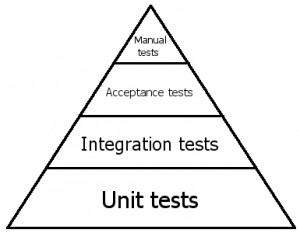
Recently I had the privilege of hearing Uncle Bob Martin talk at the Columbus Ruby Brigade. Among the many nuggets of wisdom that I learned that night, my favorite part was the Automated Testing Triangle. I don’t know if Uncle Bob made this up or if he got it from somewhere else, but it goes something like this.

The Automated Testing TriangleAt the bottom of the triangle we have unit tests. These tests are testing code, individual methods in classes, really small pieces of functionality. We mock out dependencies in these tests so that we can test individual methods in isolation. These tests are written using testing frameworks like NUnit and use mocking frameworks like Rhino Mocks. Writing these kinds of tests will help us prove that our code is working and it will help us design our code. They will ensure that we only write enough code to make our tests pass. Unit tests are the foundation of a maintainable codebase.

But there will be situations where unit tests don’t do enough for us because we will need to test multiple parts of the system working together. This means that we need to write integration tests — tests that test the integration between different parts of the system. The most common type of integration test is a test that interacts with the database. These tests tend to be slower and are more brittle, but they serve a purpose by testing things that we can test with unit tests.

Everything we’ve discussed so far will test technical behavior, but doesn’t necessarily test functional business specifications. At some point we might want to write tests that read like our technical specs so that we can show that our code is doing what the business wants it to do. This is when we write acceptance tests. These tests are written using tools like Cucumber, Fitnesse, StoryTeller, and NBehave. These tests are usually written in plain text sentences that a business analyst could write, like this:
As a user
When I enter a valid username and password and click Submit
Then I should be logged in

At this point, we’re are no longer just testing technical aspects of our system, we are testing that our system meets the functional specifications provided by the business.

By now we should be able to prove that our individual pieces of code are working, that everything works together, and that it does what the business wants it to do — and all of it is automated. Now comes the manual testing. This is for all of the random stuff — checking to make sure that the page looks right, that fancy AJAX stuff works, that the app is fast enough. This is where you try to break the app, hack it, put weird values in, etc.

The un-automated testing triangleI find that the testing triangle on most projects tends to look more like this triangle. There are some automated integration tests, but these tests don’t use mocking frameworks to isolate dependencies, so they are slow and brittle, which makes them less valuable. An enormous amount of manpower is spent on manual testing.

Lots of projects are run this way, and many of them are successful. So what’s the big deal? Becuase what really matters is the total cost of ownership of an application over the entire lifetime of the application. Most applications need to be changed quite often, so there is much value in doing things that will allow the application be changed easily and quickly.

Many people get hung up on things like, “I don’t have time to write tests!” This is a short term view of things. Sometimes we have deadlines that cannot be moved, so I’m not denying this reality. But realize that you are making a short term decision that will have long term effects.

If you’ve ever worked on a project that had loads of manual testing, then you can at least imagine how nice it would be to have automated tests that would test a majority of your application by clicking a button. You could deploy to production quite often because regression testing would take drastically less time.

I’m still trying to figure out how to achieve this goal. I totally buy into Uncle Bob’s testing triangle, but it requires a big shift in the way we staff teams. For example, it would really help if QA people knew how to use automated testing tools (which may require basic coding skills). Or maybe we have developers writing more automated tests (beyond the unit tests that they usually write). Either way, the benefits of automated testing are tremendous and will save loads of time and money over the life of an application.


Kick It on DotNetKicks.com

Announcing TDD Boot Camp - comprehensive test-driven development training in .NET

Posted on February 2nd, 2010 in TDD by Jon Kruger

If any of you have tried to learn test-driven development, you’ve probably discovered that it is not easy to learn. It’s not something where you can just go read a book or find a few good blog posts and start doing it tomorrow. You have to learn to how to write tests first, how to use testing frameworks, how to write testable code, how to do dependency injection, how to use mocking frameworks, and on and on.

People have asked me for advice on how to learn TDD and I really haven’t had a good answer for them. I’ve tried doing lunch and learn sessions on TDD and other people have done half-day sessions on TDD. All of these are good, but there’s no way that you can cover all of the subjects that you would need to understand in order to do TDD on real world projects in such a short amount of time. Sure, there’s definitely value in these sessions, but when I did my lunch and learn session on TDD, I felt like people went away feeling more confused about all of the stuff that they just realized that they didn’t understand.

Which is why I’m developing the TDD Boot Camp, a comprehensive, three day training course that will cover everything that you need to know in order to do TDD on real world .NET projects. It will be very hands-on with a lot of coding exercises that will help you understand all of the hows and whys of test driven development in .NET. My goal is to teach all of the concepts, tools, and techniques that you need to know to do TDD so that, with some practice, you will effectively be able to do TDD (and hopefully teach others how to do it too!).

I’m working on scheduling some events, so keep an eye on the website as I get things set up. I can also come out to your site if that would work better. Hopefully this will fill in the TDD learning gap so that more people can start realizing the benefits of test driven development.


Kick It on DotNetKicks.com

The business value of test-driven development

Posted on January 25th, 2010 in TDD by Jon Kruger

Most businesses are creating software for one primary reason — to make money. In order to make money, we need software that meets the needs of the business and can be developed and maintained in a reasonable amount of time with a high level of quality. Test-driven development is a discipline that will help you achieve these goals.

Test-driven development involves writing automated unit tests to prove that code is working. The test code is written before the implementation code is written. By writing the tests first, you will know when the code is working once the tests pass. Test names are written as sentences in plain English so that the tests describe what the code is supposed to do. Over time, you will end up with a large suite of automated tests which you can run in a short amount of time. These tests will prove to you that your code is working and will continue to work as you modify or refactor the code base.

Most software applications are intended to be used for many years, and throughout most of their existence, someone will be changing them. The total cost of ownership of an application goes far beyond the cost of the initial effort to create the initial version of the software. The first release is the easy part — you can build the application from the ground up, you don’t have many hindrances, and developers feel very productive. But as time goes on, productivity tends to decrease due to complexity, developer turnover, poor software design, and any number of other reasons. This is where software development really becomes expensive. So much focus is placed on the original cost of building an application without considering how the original development effort will affect the cost of maintaining that application over several years.

Test-driven development can reduce the total cost of ownership of an application. New developers on the team will be able to change the code without fear of breaking something important. The application will have fewer defects (and far fewer major defects), reducing the need for manual QA testing. Your code will be self-documenting because the tests will describe the intended behavior of the code. All of this leads to flexible, maintainable software that can be changed in less time with higher quality.

Software is intended to deliver business value, and test-driven development will help you write higher quality, more maintainable software that can be changed at the fast pace of the business. Test-driven development will lead to successful software projects and enable you to write software that will withstand the test of time.


Kick It on DotNetKicks.com

Make TDD your meal ticket in 2010

Posted on December 21st, 2009 in TDD by Jon Kruger

It’s almost the time of the year where people start making new year’s resolutions and setting goals for the upcoming year. Allow me to propose something for your list: make TDD your meal ticket in 2010.

Why do I say this? Because TDD has revolutionized the way I develop software and has helped me write flexible and maintainable software with fewer defects and is a less stressful way to get things done. I can’t imagine ever going back to writing code without tests, and as a result it’s really difficult to work with developers who don’t write tests because they will write code that is hard to test, which means I won’t be able to write tests either.

In today’s economy, it’s important to differentiate yourself from the crowd if you’re looking for a job, hoping to get a raise, trying to get a promotion, etc. TDD can be that thing that differentiates you from everyone else out there. When I worked at Quick Solutions, we were always looking for developers who practice TDD, but developers with any amount of TDD experience are very hard to find.


Kick It on DotNetKicks.com
Next Page »